





We often get asked “Can You Put Shutters on Patio Doors?” The answer is yes, and it’s one of our favourite transformations. Plantation shutters can be fitted to patio doors, and in most cases they’ll outshine curtains or blinds. What changes is how.
The right shutter system depends entirely on the door underneath it: whether it’s a hinged French door, a sliding patio door, or a bifold door. Get that wrong and you’ll end up with panels that won’t clear the door swing, won’t stack away neatly, or put unnecessary strain on the hinges, which can drop over time. Get it right, though, and your patio door shutters will look fabulous, and operate seamlessly.
As a measure-and-fit company, this is exactly why we don’t quote from a photo or a rough tape-measure. Our specialists assess every door on-site, in person, before we recommend a system built for your doors, not just any doors.
Table of Content
- Types of Patio Doors and Recommended Shutters
- Shutters for French doors
- Shutters for sliding doors
- Shutters for bifold doors
- How tracked door shutters work
- How much are patio door shutters?
- How We Measure and Install Shutters on Patio Doors
- FAQs about patio door shutters
Types of Patio Doors and Recommended Shutters
| Door type | How it opens | Typical shutter approach |
| French doors | Hinged, swings in or out, usually a pair | Hinged shutters, or tracked on wider French doors |
| Sliding glass doors | Slides horizontally on a fixed track | Tracked shutters |
| Bifold doors | Multiple panels concertina and stack to one or both sides | Tracked shutters |
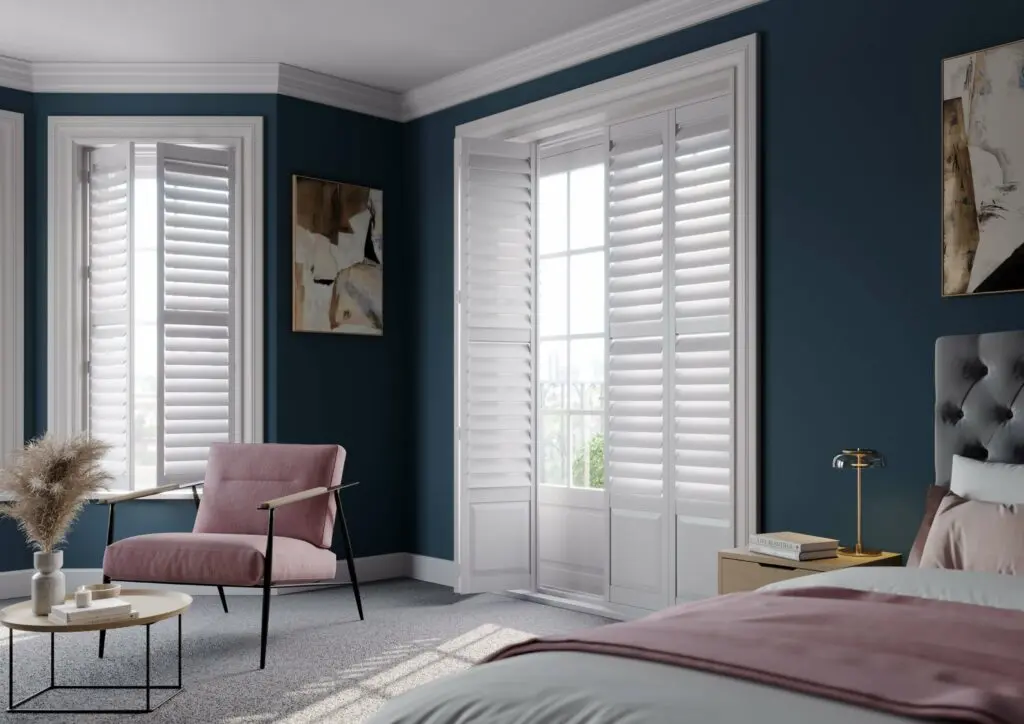
Can You Put Shutters on French Doors?
Our Shutter Specialists Recommend: Hinged shutters or tracked shutters
Good news, both standard hinged shutters and tracked shutters can be fitted to French doors. Which one we’d recommend comes down to how you actually use the door, and what’s around it.
Hinged shutters are the classic plantation look, and they’re a great fit for French doors that open only occasionally rather than serving as the main way in and out, as long as there’s flat wall space either side for the panels to fold back against, or a reveal deep enough for them to tuck into. For a single pair of standard-width French doors, this is usually our first suggestion.
Tracked shutters step in when:
- Your French doors are on the wider side (think triple or quad sets, or two pairs side by side)
- The doors get used constantly as a main access point, and the panels need to clear out of the way, fast, tracked shutters are simply more convenient here
- There isn’t quite enough wall space for hinged panels to fold back without bumping into a radiator, furniture, or anything else in the way
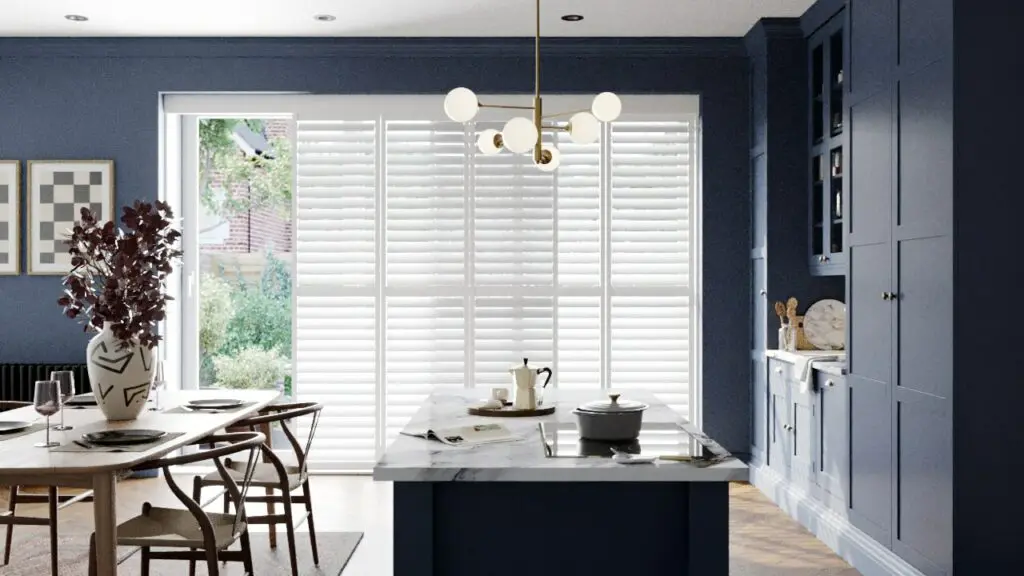
Can You Put Shutters on Sliding Doors?
Our Shutter Specialists Recommend: Tracked Shutters
Here, hinged shutters just don’t cut it, and there are two good reasons why. First, hinged panels need room to swing open, then wall space to sit folded back against, and sliding doors are usually chosen for exactly the opposite reason: because the room doesn’t have that kind of space to spare.
Second, hinged shutters are generally fixed to the reveal, but a sliding door moves right along its track through that same space as it opens, so a fixed hinged panel would simply be standing in the way.
A tracked system sidesteps both problems at once. It needs no swing clearance, and it moves entirely independently of the door rather than getting caught up in its path.
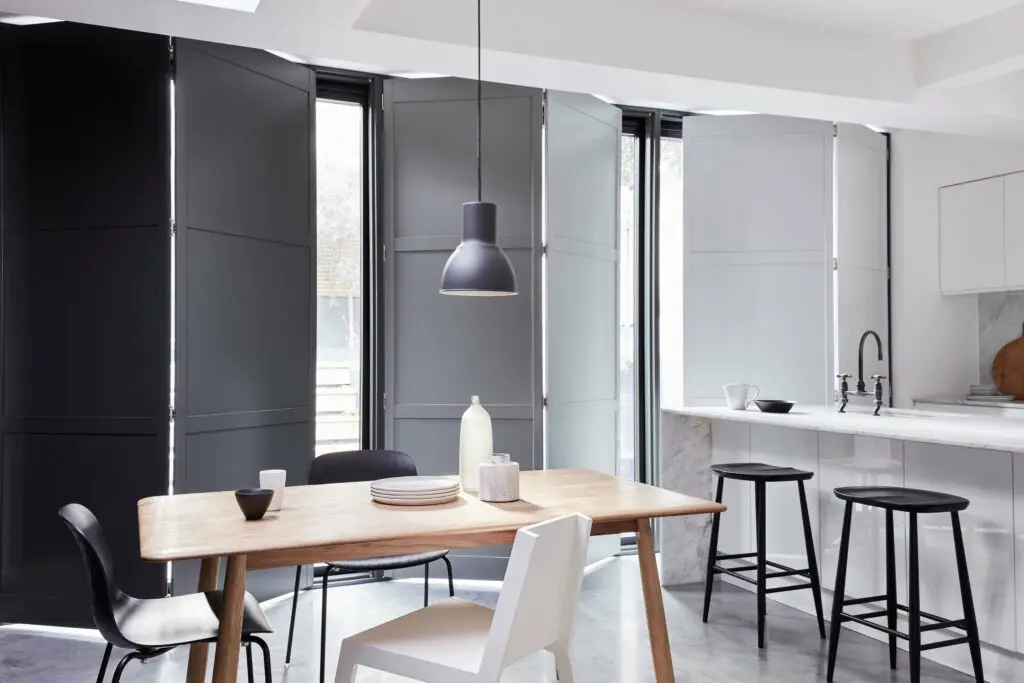
Can You Put Shutters on Bifold Doors?
Our Shutter Specialists Recommend: Tracked Shutters
Bifold doors are usually wide, multi-panel openings, which means the shutter panels covering them are large and heavy, more than standard hinges are built to carry, long term. Ask too much of ordinary hinges and they’ll give under the weight eventually, leaving panels drooping.
A tracked system carries that weight exactly as it should, keeping everything running smoothly for years to come. The shutters ride on their own rail above the bifold door’s track, moving completely independently of the folding leaves beneath them.
How Do Tracked Door Shutters Work?
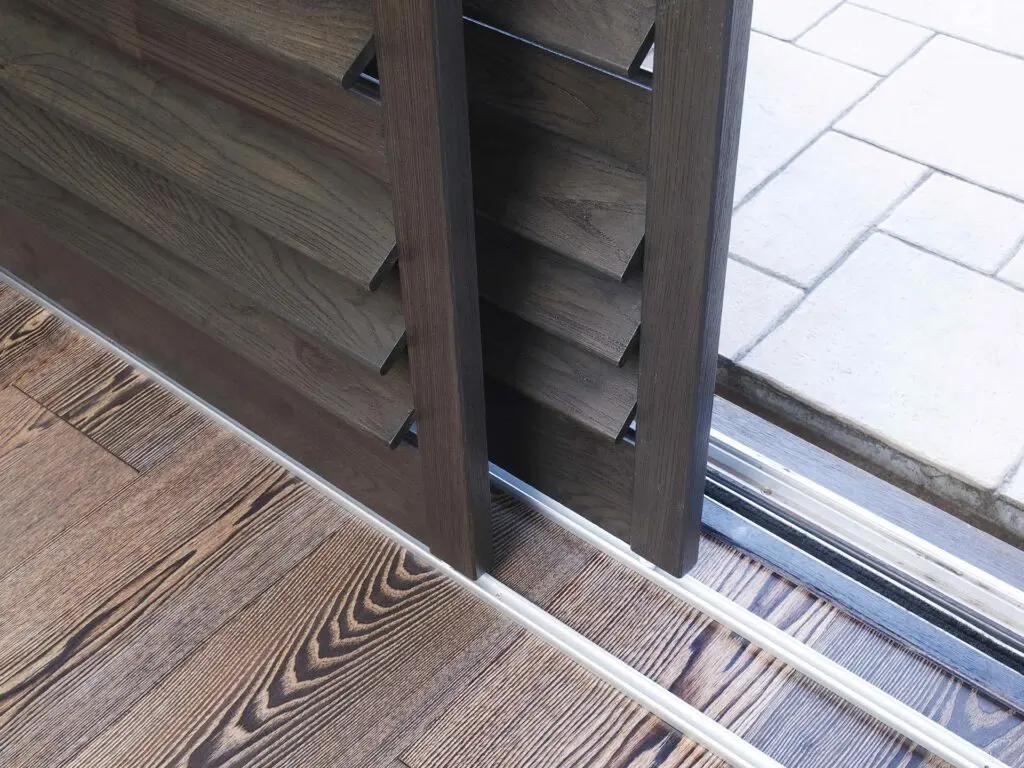
A top rail is fixed to the head of the opening into the reveal, the ceiling, or a fitted pelmet, depending on what you’re working with, and the shutter panels glide along it on carriers, entirely independent of the door’s own track below. Two configurations are available:
Bifold track: the more popular of the two. Panels are hinged together and concertina along the rail, held at the top (or top and bottom) so they hold their line smoothly as they fold. Louvres need to be closed before the panels can concertina flat against one another, and the whole set folds away to clear the opening completely.
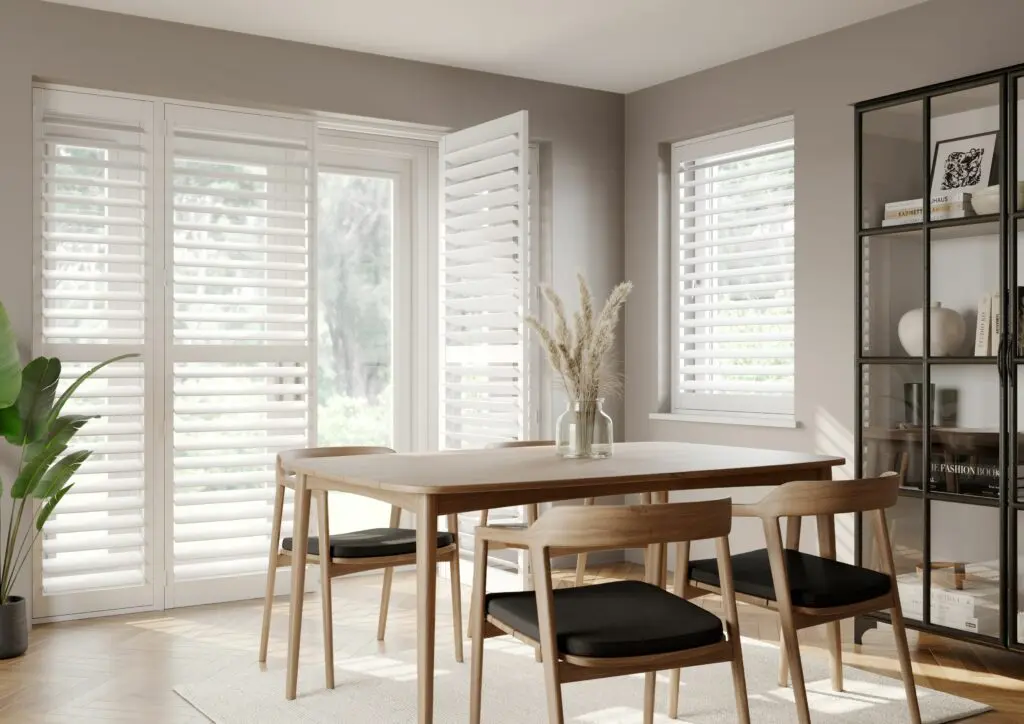
Bypass track: panels stay parallel to the opening rather than folding, held top and bottom on two parallel rails so they glide past one another. Because they never concertina away, there’s always a panel or two covering part of the opening, which makes this the less common choice, though it’s often the best (sometimes only) option where space is tight and there’s no room for a bifold stack.
How Much Are Patio Door Shutters?
We’ve popped some example costs below for hardwood shutters in a typical French door, a medium sliding door and a bifold door, just to give you a feel for the numbers. For an accurate cost, book your free, no-obligation appointment and one of our specialists will survey your doors and windows in person and give you a firm price, no guesswork, no surprises.
| Approx. door size | Hardwood Shutter |
| 4 sq m — small French doors (e.g. 1.8m × 2.1m) | £1,389 |
| 7 sq m — medium sliding door (e.g. 3.3m × 2.1m, 3 panels) | £2,547 |
| 10 sq m — bifold door (e.g. 4.8m × 2.1m, 4 panels) | £3,704 |
Prices are correct as of 22 September 2026 and may change (includes 25% off promotion).
How We Measure and Install Shutters on Patio Doors
We survey every door in person before we quote. What our surveyor actually checks:
- Precise width and height at multiple points (openings are rarely perfectly square)
- Reveal depth and wall space either side, for fold-back or stacking clearance
- Handle, lock and hinge projection
- Floor level and threshold type, especially where a bottom track is being considered
- What the head/ceiling is fixing into — stud, masonry, a lintel — which determines the fixing method
- Door swing direction, particularly on bifold doors that open inward
- Nearby obstructions: radiators, sockets, blinds, alarm sensors
Then we get to work. Every door shutter is made to the exact measurements from your survey. Fitting is carried out by our own trained shutter specialists, using fixings suited to whatever’s actually behind your wall or ceiling, and we check that both the shutters and the door operate smoothly together before we call it done.
FAQs about installing shutters on doors
Most French and bifold doors are hinged to open outwards, though inward-opening configurations do happen on both. It’s still workable, during your survey we’ll check the door’s swing and, where clearance is tight, typically solve it with a bespoke frame or by fixing the shutters proud of the recess so they clear the doors as they open.
Much easier than curtains or blinds, a quick dust with a dry cloth or the brush attachment on your vacuum keeps them looking sharp, and a damp cloth lifts any marks. There’s no fabric to take down and wash or dry clean, which matters on a door that gets opened, closed and touched more than any other in the house.
After your free survey, it depends on the size of your door and the type of shutter. If you’re dressing a smaller door with standard hinged shutters, you can choose faux wood or hardwood. Faux wood is made to order here in the UK and can be fitted in as little as two weeks. Hardwood typically takes around 12 weeks because it follows a longer supply chain. Larger doors that need tracked shutters are made in hardwood only, so allow around 12 weeks. Your shutter specialist will confirm timings for your new door shutters when they quote.